The baby's coming.
What about your big kid?
A short book where the hero is your older child — not the baby. Not to fix jealousy: to give them a story of their own, one they can ask you to re-read as many times as they need.
- First book free
- No credit card
- Written in real Quebec French
"Will they think we love them less?"
That's the question that wakes you at three in the morning — not the one in the book from the shop. This one is built for it.
A child gets ready by retelling.
A four-year-old doesn't get ready for a change by having it explained to them. They get ready by playing it, telling it, repeating it. That's why books about big changes have always existed, and why everyone around you is about to recommend one.
The trouble with the one from the bookshop: the heroine is called Mia, she has a cat, and her mum already explained everything calmly on page 3. Your child has a different name, maybe a dog, and what worries them isn't what worries Mia.
That's the one thing Toupie adds: the hero is your kid. The rest — the short format, the bedtime rhythm, the gentle ending — is what good books already do, and I'm not going to pretend I invented it.
"Mia is getting a baby brother. Mia is a bit sad. Then Mia is happy."
"There are boxes all over the living room. Dad is banging with his hammer. Bang, bang! Rosalie finds one tiny sock on the floor."
What's actually inside
Your child, for real
Their name, their age, their face. The troupe is made once and comes back in every book after this one — so this book isn’t a one-off.


The actual days
The waiting, the room changing, the grown-ups busy. Wanting it to happen and wanting it not to, often on the same day.
An ending that gives them a job
Not "be nice to the baby". One concrete thing that is theirs, that nobody else in the house can do for them.
You read the words before a single picture exists.
The story comes first. If it isn't right, you redo it — it costs nothing, and no illustration has been drawn yet.
Rosalie regarde son nouveau petit frère. Elle regarde le gros panier près du mur. Elle fouille au fond avec ses deux mains et tire fort.
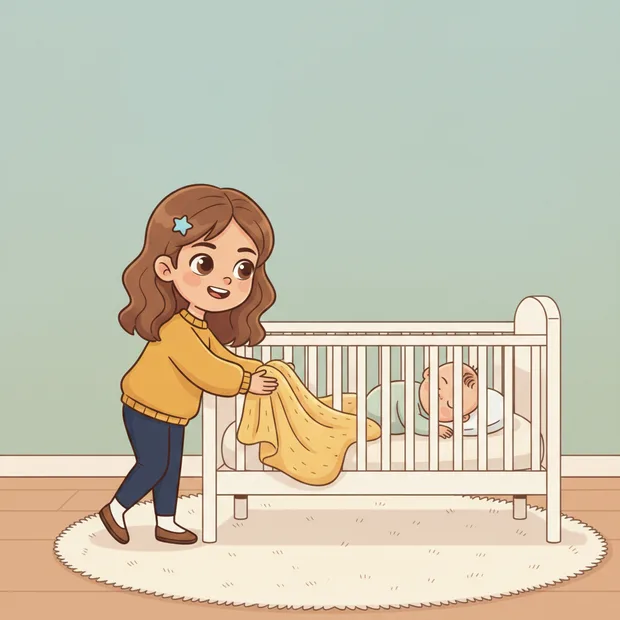
Rosalie s'approche sur la pointe des pieds. Elle dépose la couverture jaune sur les jambes du bébé. Elle flatte son petit nez avec son doigt. « Chut, chut… »
Three steps, about fifteen minutes
Create their character. A written description is enough; photos are optional and are never kept on my side.
The story starter for this moment is already waiting in the box. Change it, cut it, rewrite the whole thing if you like.
Read the text before the pictures. If the story isn't right, you redo it before a single illustration exists.
What helps, besides a book
A book is a way in. Here's what the people who actually study this recommend around it — useful whether or not you ever buy anything from me.
Tell them early, and tell them straight
The baby will cry, will take up your time, and won't be a playmate for a good while. Promising a friend right away is setting them up for a letdown.
Don't stack the big changes
If you can, finish potty training or the move to a big bed before the baby comes. Otherwise wait until the dust settles. Not both at once.
Give them a real job
Fetching a diaper, picking the pyjamas, pushing the stroller. Something concrete — not just the honorary title of big brother.
Regression is a message
Asking for the bottle again, a wet bed, extra clinginess: it isn't a step backwards, it's how they check they still have their place. It passes.
Name the feeling, hold the line
"It's okay to be angry. I won't let you hurt the baby." Both halves of that sentence matter equally.
Time that is only theirs
Ten minutes a day, no baby, no phone. It's the recommendation that shows up everywhere, and it's also the hardest one to keep.
A summary of what Naître et grandir, the American Academy of Pediatrics and the Child Mind Institute say. I'm not a psychologist — they are.
What this doesn't do
the part nobody else puts on their page ✎
- It doesn't prepare the baby. It prepares the child who is already here.
- It doesn't replace the conversation. A book opens the door; you're the one who walks through it.
- If your child is going through something heavier than a change in the family — a death, a hospital stay, a hard separation — a generated book is not the tool. Talk to your CLSC or your family doctor.
Ordinary questions
When should we read it?
Two or three weeks before the due date is the most useful window, then again in the days after the baby arrives. A child who asks for the same book twenty times isn't bored of you — it's the sign the story is doing its work.
What if the date changes?
The story names no date and counts no sleeps. If the baby comes two weeks late, the book still holds.
Can the baby be in the book?
The baby is in the story, but not as a character drawn from life — a baby who isn't born yet has no face to copy. You can add them to the troupe later, once you want them illustrated as they really are.
What does it cost?
The first book is free, no credit card. You see the full text before deciding whether to go on.
Start with the character.
First book is free, no card. The story starter is already written — you just make it yours.