Saturday, the little one sleeps over.
Their first night without their parents.
A short book where your grandchild spends their first night at your place — before they spend it for real. Their parents make it, and you're in it. Not to stop them missing their parents: so that your house and the way you say goodnight are already in a story they know.
- First book free for them
- No credit card
- Written in real Quebec French
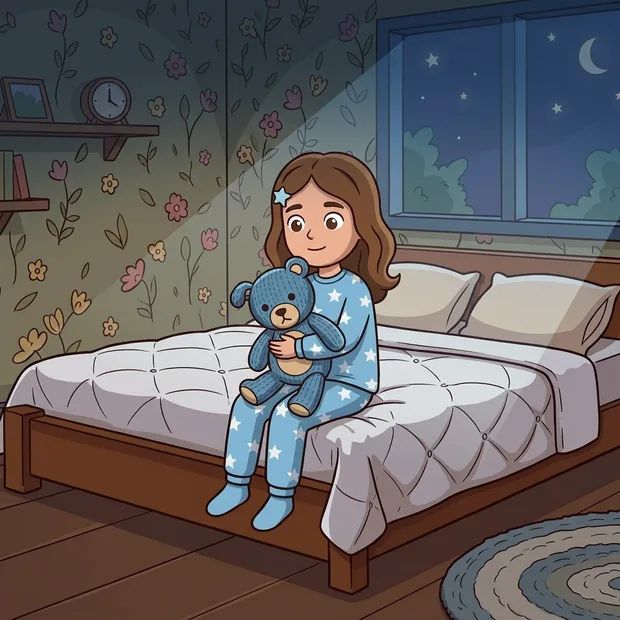
"What if they wake up at 2 a.m. crying to go home?"
You raised kids; you know how this goes. But they don't know your house at night yet — the hallway, the sounds, the light coming from the wrong side. That's where this starts.
On Saturday, they'll already know your voice.
What's scary at night at your place isn't you. It's the bed that isn't theirs, and above all the sounds: the creaky stairs, the fridge kicking on, the furnace starting up. In their own house they know every one. At yours, they know none.
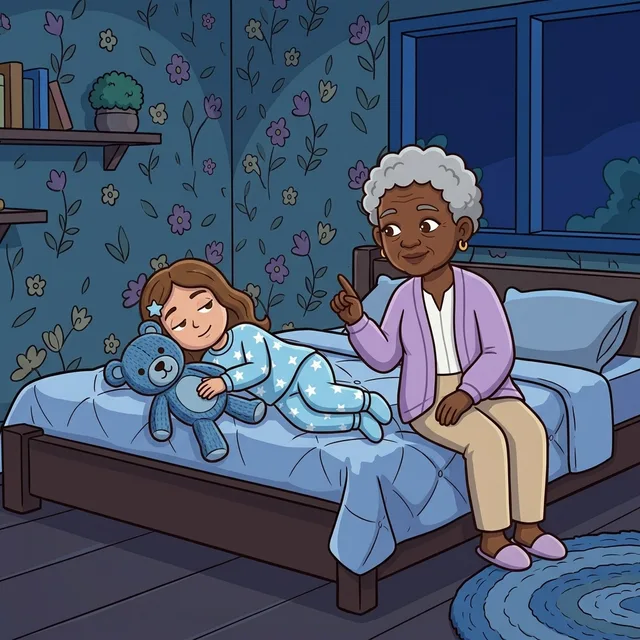
In the book I made for this page, the moment that matters isn't the one where the little girl turns brave. It's the one where her grandmother sits on the edge of the bed and names the sounds, one by one. Read a few evenings before, it means that on Saturday, when the stairs creak, they'll already know what it is — and who told them.
The book doesn't make them brave. It gives them your voice ahead of time.
"Listen. Creak. Crack. That's the stairs stretching for the night."
The real stairs creak. You just say the line from the book.
What's actually inside
Your grandchild — and you
Their name, their age, their face — and yours: the parents add you to their troupe once, and you come back in the books after this one.


The actual evening
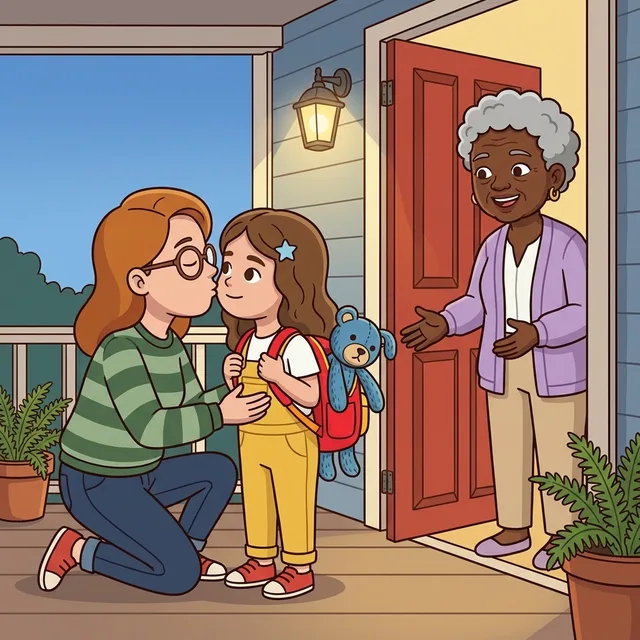
The backpack, the bye-bye on the doorstep, pyjamas in a bed that isn't theirs. And the sounds the house makes once the light goes out.
An ending at breakfast
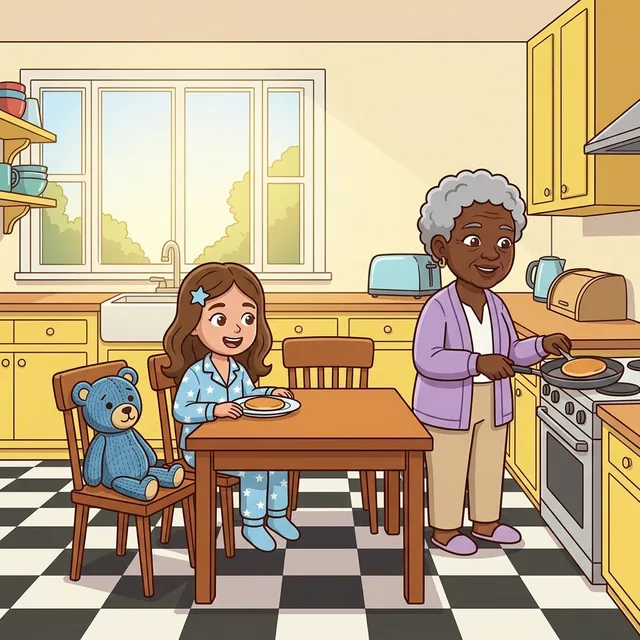
Not "be brave". They wake up, it's light out, there are pancakes. And the parents come back, for real, on the last page.
You, in a book.
Three pages from the real book: the hand-off on the doorstep, the sounds of the night, the pancakes. Ginette is invented. In yours, it's you, drawn from what the parents give.
What makes the book yours
The book comes from what the parents write in the story starter. They don't know your house at night: if they don't describe it, the book will make it up. The "Send the idea to the parents" button drafts their message with these lines left blank for you.
The sounds of your house
The creaky stairs, the fridge, the furnace, the train in the distance. That's the heart of the book — it's what they'll hear on Saturday.
Your nightlight
Or the door left ajar, or the hallway light. Whatever stays on when you close the door.
Your goodnight
A song, a phrase, a butterfly kiss. What you do that the parents don't.
The bed they'll sleep in
The guest bed, the couch, their mom's or dad's old room. In the book, they'll see it before Saturday.
Breakfast
Pancakes, oatmeal, toast with peanut butter. The book ends there.
The parents make the troupe — the little one, and you — and add this to the story starter in a few words. They read the text before the pictures, and their first book is free, no card.
What helps, besides a book
A book is a way in. Here's what the people who actually study this recommend around it — worth reading with the parents, whether or not you ever buy anything from me.
Build up to it
An hour, then an evening, then a day, then the night. There's no ideal age; it depends on the child. And if another big change is underway — a move, a new daycare — it can be worth waiting.
The stuffie, and a piece of home
The stuffed toy, obviously. But also a sheet from their bed, or a piece of clothing that smells like mom or dad. The smell of home does part of the work.
Same routine, same order
Ask the parents how it goes at home: bath, story, song, nightlight. Recognizing the steps is reassuring. The rest can be a bit different — kids adapt.
A real goodbye, a short one
The parents say a proper goodbye, with a little ritual that's always the same, and don't linger. Slipping out while the child is busy playing can feel to them like being left.
Say when they're back, with a marker
"After breakfast" rather than "tomorrow at ten". Then be back when promised — that's what makes the next time easier.
A rougher night happens
Falling asleep may take longer, they may wake more often, sulk a little the next day. It isn't a failure. It's a first time.
A summary of what Naître et grandir ("Dormir ailleurs sans ses parents") and the American Academy of Pediatrics say. I'm not a specialist — they are.
What this doesn't do
the part nobody else puts on their page ✎
- It doesn't guarantee a night without tears. It makes your house a little less strange.
- It doesn't draw your actual house: it comes from the description. The sounds, the nightlight, the song — those, yes. Tell the parents.
- It doesn't replace someone sitting on the edge of the bed. A book opens the door; you're the one who walks through it.
- If your grandchild is sleeping at your place because of something heavier — a parent in hospital, a hard separation, a death in the family — a generated book is not the tool. Talk to your CLSC or your family doctor.
Ordinary questions
When should we read it?
A few evenings before, at home, with their parents. Then on the night itself, at your place, at bedtime — they can send it to you as a PDF or a reading link. A child who asks for the same book twenty times isn't being difficult — it's the sign the story is doing its work.
Why can't I make it myself?
Because a Toupie account is opened in the parent's name: they're the one who agrees on their child's behalf, especially if there are photos. You bring the idea — and you're in the book.
What if I want to give it?
You buy books as a gift without making an account, and you get a code by email to hand to the parents. Send them the idea at the same time: the code doesn't carry it. And if it's their first book, it's already free — the gift is for the ones after.
What does it cost?
For the parents, the first book is free, no credit card, and they see the full text before deciding whether to go on. As a gift, it's 2, 5 or 10 books, paid once, and the code never expires.
Send them the idea.
Their first book is free, no card. The story starter is already written — they just make it theirs. Or give them the ones after.